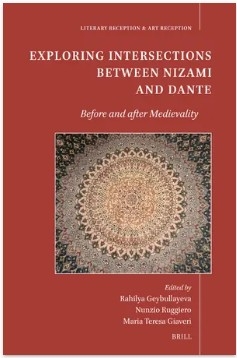
A new book titled "Exploring Intersections between Nizami and Dante" has been published by Brill, one of the world's leading academic publishing houses based in the Netherlands. The editors of the publication are Rahilya Geybullayeva, Nunzio Ruggiero, and Maria Teresa Giaveri.
The book examines cultural, philosophical, and literary parallels between Islamic and Christian civilizations through the works of Nizami Ganjavi and Dante Alighieri. The approach, built upon the concept of "before and after," brings a new perspective to medieval cultural heritage, shedding light on medieval symbols such as beauty, wine, wisdom, sacred and profane passion, spiritual values, and the changing role of love in the human soul.
The publication also includes Chapter 19, titled "Nizami's Philosophy of History," authored by Prof.Acad. Hamlet Isakhanli, founder of Khazar University and Chairman of the Board of Directors and Trustees. Prof.Acad. Isakhanli explores the works of Nizami and Dante from the perspective of philosophical ideas, political views, and historical thought. The chapter notes that the historical figures in Nizami's poems "Khosrow and Shirin" and "Seven Beauties" are built upon the ideas of love and just ruler. It emphasizes that Nizami's greatest work, "Iskandarnameh," encompasses concepts of world history, world geography, and the ideal ruler, and that the poet presents Alexander beyond real historical boundaries through deliberate anachronisms.
The chapter also notes that Nizami depicts Alexander as a world ruler engaging in philosophical conversations with seven Greek philosophers, only one of whom was his actual contemporary. This creative approach is analyzed in comparison with Dante, offering a new perspective on the formation of medieval historical memory.
Information about the book's presentation to the general public will be announced in the coming days.


Copyright © Khazar University, 2026

 Facebook
  Instagram
  X
X  LinkedIn
  Telegram
  YouTube