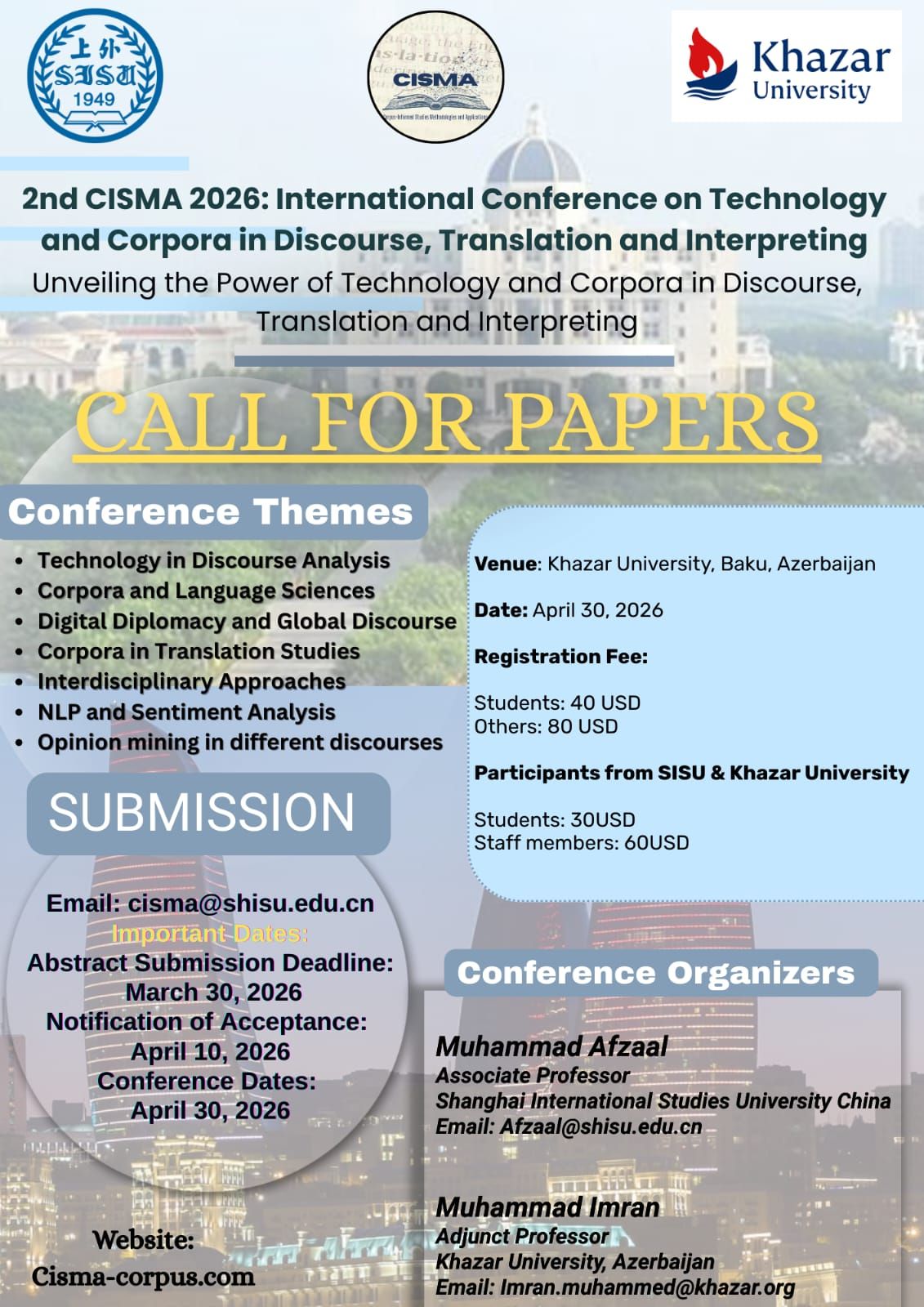
Khazar University, in collaboration with Shanghai International Studies University (SISU), is pleased to announce the 2nd CISMA 2026 International Conference on Technology and Corpora in Discourse, Translation and Interpreting, which will be held on April 30, 2026, at Khazar University, Baku, Azerbaijan.
The conference aims to bring together scholars, researchers, and practitioners to explore recent developments, innovative methodologies, and interdisciplinary perspectives on the use of technology and corpora in discourse analysis, translation studies, interpreting, and language sciences. The event seeks to foster academic exchange, encourage collaborative research, and provide a platform for discussing emerging trends in the field.
Conference Themes
Submissions are invited on topics including, but not limited to:
Technology in Discourse Analysis
Corpora and Language Sciences
Digital Diplomacy and Global Discourse
Corpora in Translation Studies
Interdisciplinary Approaches to Language Research
Natural Language Processing (NLP) and Sentiment Analysis
Opinion Mining in Different Discursive Contexts
Important Dates
Abstract Submission Deadline: March 30, 2026
Notification of Acceptance: April 10, 2026
Conference Date: April 30, 2026
Submission Guidelines
Authors are invited to submit their abstracts via email to cisma@shisu.edu.cn.
All submissions will be reviewed by the conference scientific committee.
Please note that the registration fee is indicated on the poster.
Conference Venue: Marble Hall, Khazar University, Baku, Azerbaijan
Further details regarding the conference program, keynote speakers, and participation guidelines are available on the official conference website: www.cisma-corpus.com
The conference is organized by Muhammad Afzaal, Associate Professor at Shanghai International Studies University (China), and Muhammad Imran, Adjunct Professor at Khazar University (Azerbaijan).
Scholars, researchers, and practitioners from around the world are warmly invited to submit their work and participate in CISMA 2026, contributing to meaningful discussions on the intersection of technology, corpora, and language studies.


Copyright © Khazar University, 2026
