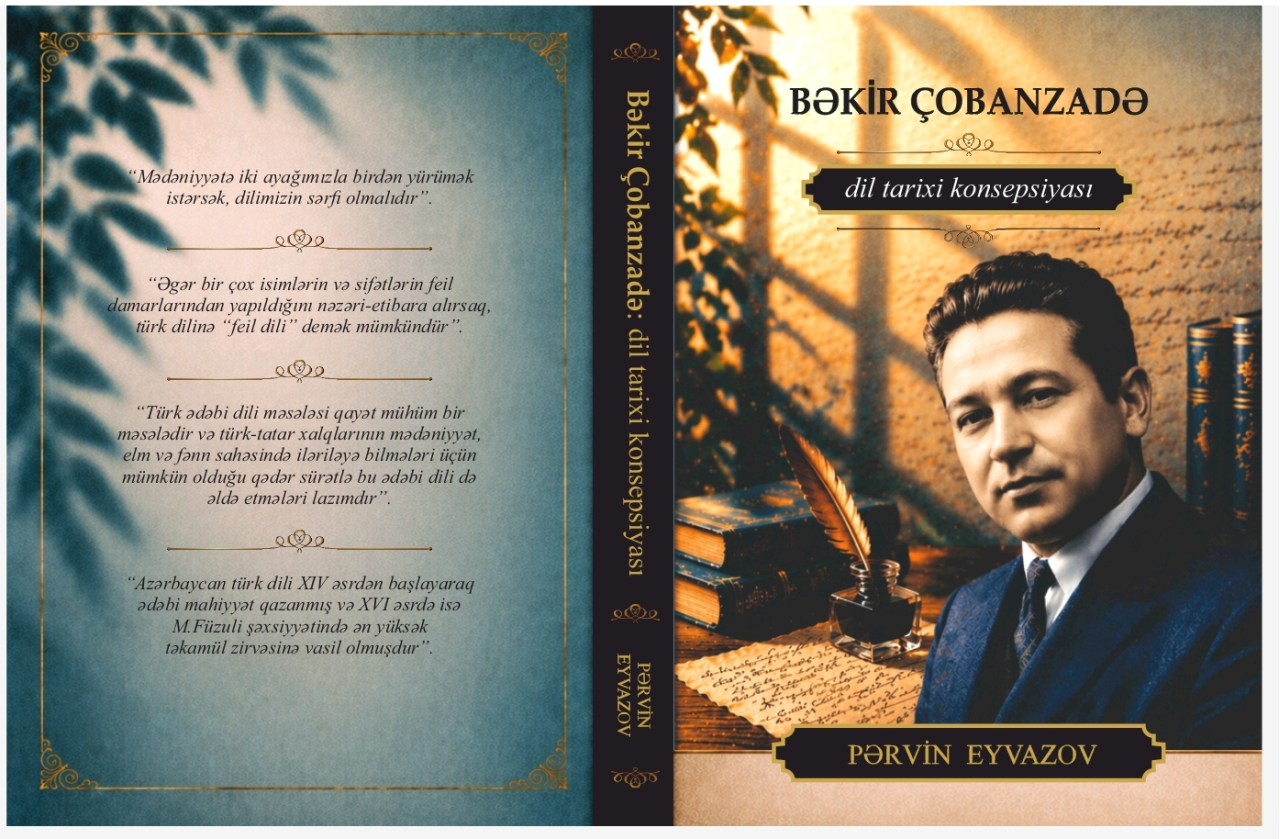
A monograph titled "Bakir Chobanzade: Conception of Language History" (Baku: "Elm" Publishing House, 2026, 296 pp.) by Parvin Eyvazov, lecturer at the Department of Languages and Literatures of Khazar and Doctor of Philosophy in Philology, has been published. Dedicated to the 100th anniversary of the First Turkological Congress (1926) and the 90th birth anniversary of Honored Scientist, Order of "Shohrat" laureate, and Academician Tofig Ismayil oglu Hajiyev (1936–2015), the monograph presents the first comprehensive study of issues related to the history of language in the scholarly work of the distinguished Turkologist and professor Bakir Vahab oglu Chobanzade. The book examines Chobanzade's scholarly views on the history of language across four chapters, in the context of historical grammar and literary language, with a systematic analysis of various issues pertaining to the historical development of phonetic, lexical, and morphological structures. In addition, the scholar's conception of the literary language is explored in depth, with his views on the periodization of literary language history, the language of literary figures, and the common Turkic literary language subjected to comparative analysis in light of contemporary scholarly thought.
The chief scientific editor and author of the Foreword is Professor Tofig Hajiyev, Head of the Department of Azerbaijani Linguistics at BSU; the scientific editors are Professor Maharram Mammadov, Head of the Department of Turkology, and Doctor of Philological Sciences Gizilgul Abdullayeva; the reviewers are Professor Reyhan Habibli of the Department of Azerbaijani Linguistics at BSU, Professors Ahmet Buran and Suleyman Kaan Yalçın of Fırat University in Türkiye, and Assoc. Prof. Kenan Acar of Kocaeli University.
The materials of the monograph may be drawn upon in future research dedicated to Chobanzade's scholarly legacy, in studies on Azerbaijani linguistics — including issues of language history — as well as in the preparation of textbooks and teaching aids in this field. In this regard, the book will be of value to specialists engaged in teaching and research in the field of Turkological linguistics: faculty members, young researchers, students, and all those interested in the scholarly heritage of Chobanzade.


Copyright © Khazar University, 2026

 Facebook
  Instagram
  X
X  LinkedIn
  Telegram
  YouTube