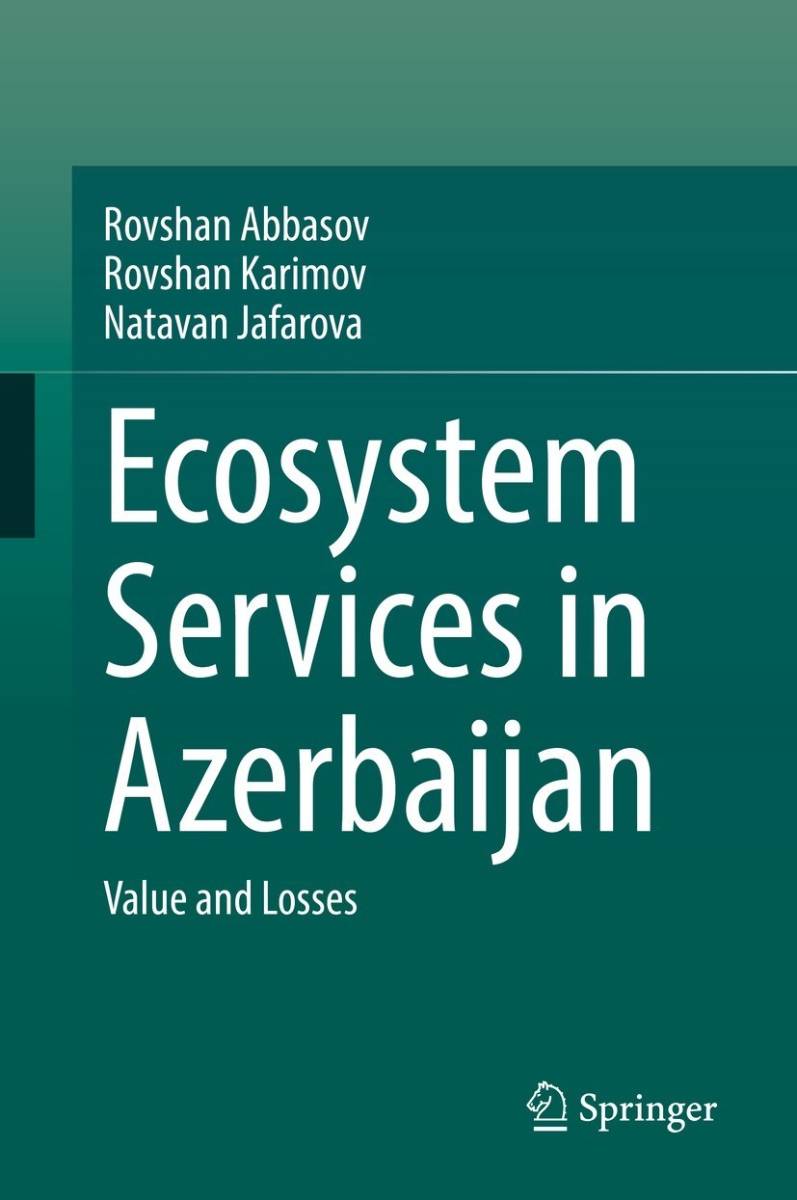
The book "Ecosystem Services in Azerbaijan: Value and Losses" written by Rovshan Abbasov, head of Khazar University Geography and Environment Department, was published by the prestigious Springer publishing house.
Professor Hamlet Isakhanli, founder of Khazar University, chairman of the Board of Directors and Trustees, wrote a foreword to the book.
Rovshan Abbasov has been conducting research in the field of environmental management for many years. Its main activities are dedicated to the management of transboundary rivers, nature values, disaster risk reduction and the management of hazardous pollutants. He currently works as an expert on projects such as climate change impacts on water resources and coastal management with organizations such as the United Nations Development Program and IPBES. Rovshan Abbasov has been a member of the Interdisciplinary Expert Council of IPBES since 2018. He is also the lead author of the National Ecosystem Assessment for Azerbaijan.
The co-authors of the book are Rovshan Karimov and Natavan Jafarova.
Rovshan Karimov works as a senior researcher at the "Population demography and geography" department of the Institute of Geography of the Azerbaijan National Academy of Sciences. He has
worked as a consultant on a number of projects, including migration, socio-economic development, climate change and ecosystem services, and served as a focal point for some international programs and projects. He participated in staff mobility campaigns within the framework of several Erasmus+ projects. Participated in staff mobility campaigns within several Erasmus+ projects.
Natavan Jafarova is a senior researcher at the "Political and Economic Geography" Department of the Institute of Geography of the Azerbaijan National Academy of Sciences. Her scientific-research works are devoted to the geographical features of population settlement, socio-economic development of regions, study of natural hazards through remote sensing and GIS mapping.
The book "Ecosystem Services in Azerbaijan: Value and Losses" aims to draw readers' attention to the benefits of the natural environment in Azerbaijan. Over the last hundred years, these values of the natural environment have been decreasing under the influence of various factors. Therefore, a part of the values that once existed have been lost in the last 200 years as a result of neglecting nature. For example, oil pollution and unregulated fishing of the Caspian Sea during the Soviet era almost completely reduced its fish and caviar stocks. As a result of mass migration from mountainous regions, human-nature relations were seriously damaged.
In this book, the authors distinguish between the concepts of "profit" and "income" and show readers that short-term benefits based only on monetary income deprive people and nature itself of long-term, sustainable value. The book provides readers with real historical information, discusses the interaction between man and nature, shows the consequences of anthropogenic activity on natural resources in Azerbaijan with real data and trends. Research covers fish, water, forest, mountain and grassland ecosystems, focuses on the effects of pollution and other forms of environmental degradation on these resources, and shows the impact of resource depletion on human livelihoods.
The book consists of four chapters.
The first chapter talks about the Caspian Sea and its values. The Caspian Sea is the largest closed body of water in the world. This precious ecosystem has many values. At one time, sturgeon living in the Caspian Sea accounted for 90% of the world's sturgeon. At the same time, this lake has great recreational importance. The Caspian Economic Zone is a region where about 100 million people live. The Caspian Sea has both use and non-use values. In this section, all the values of the Caspian Sea are classified, and at the same time, the factors that change these values and show many important trends are discussed in detail, and it is justified how short-term abuse of marine resources leads to long-term losses.
The second chapter talks about the values of mountain ecosystems of Azerbaijan. Climate change and increasing anthropogenic impacts pose serious threats to the ecosystem services provided by highlands. As a result, many communities abandon their traditional activities and move to the city and gradually forget them. Land degradation, water scarcity, gradual increase in extreme natural hazards are the main negative manifestations observed.
The third chapter talks about the value of Azerbaijan's water resources. The country's location in the lower reaches of the Kura River and the inefficient use of water have endangered the availability of water resources, and many water ecosystems have lost their original value. More than 70 percent of the country's water resources, located in the lower reaches of the Kura-Araz basin, are formed outside. The increase in water withdrawals in the uplands threatens the existence of rivers as an ecosystem, while at the same time causing serious water shortages in the country. On the other hand, the country's poor irrigation infrastructure and outdated irrigation technologies drastically increase water losses, resulting in water scarcity.
The fourth chapter discusses the mass migration events related to the environment and how these historical migrations affect traditional life in small villages, human-nature relations, and their future existence. It is shown that the population decrease in a number of mountain villages of Azerbaijan caused not only the existence of these villages, but also the loss of very valuable natural knowledge.
The book is mainly intended for managers, politicians, science and education specialists, students, and will also be of interest to naturalists, historians and cultural workers.


Copyright © Khazar University, 2026

 Facebook
  Instagram
  X
X  LinkedIn
  Telegram
  YouTube