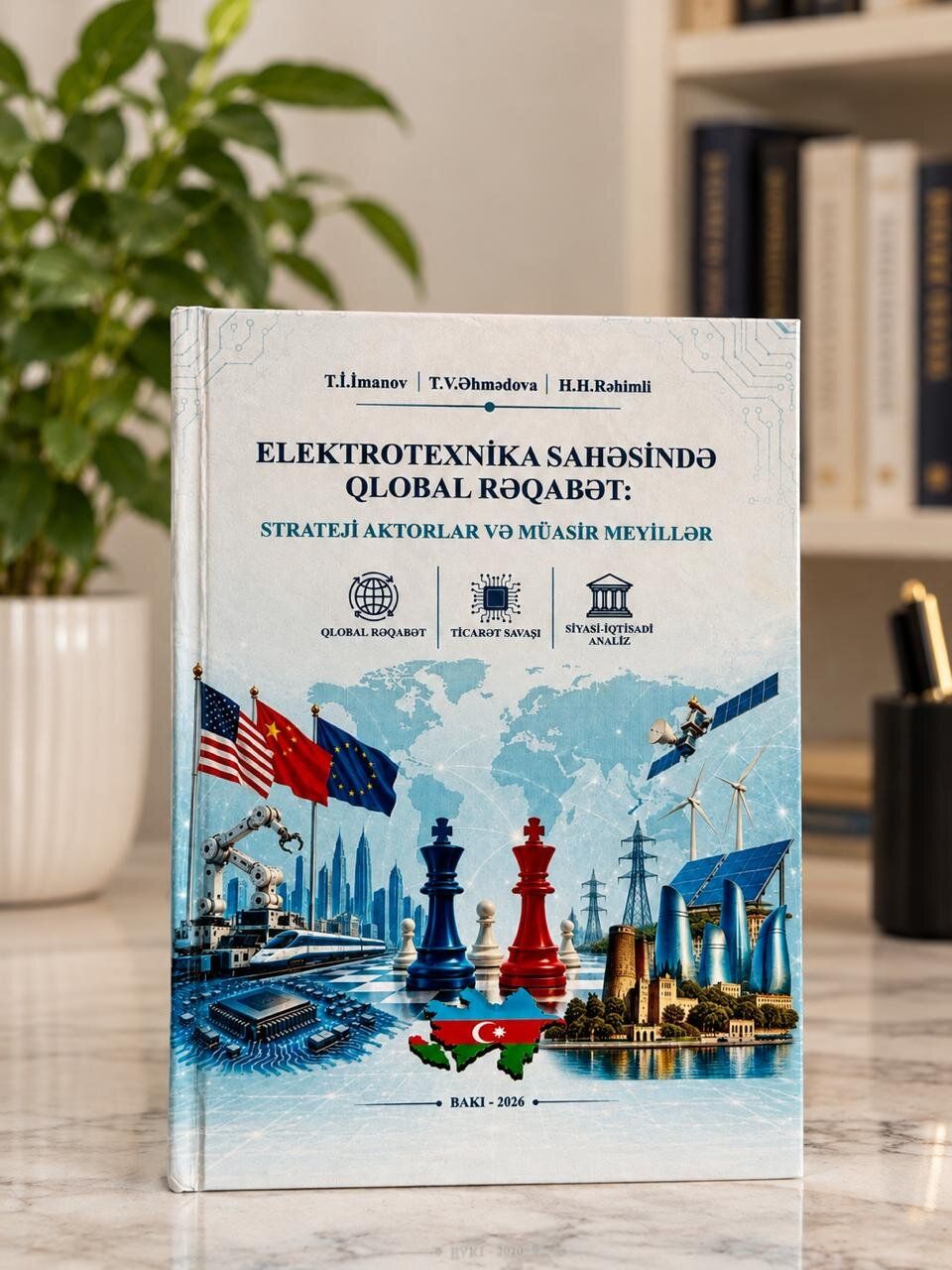
A new monograph entitled “Global Competition in the Electrical Engineering Industry: Strategic Actors and Contemporary Trends”, co-authored by Hasan Rahimli, a Academic Staff member of the Department of Economics and Management, has been published.
Prepared under the general academic editorship of Professor T.I. Imanov, Doctor of Economics, the monograph is authored by Professor T.I. Imanov, Associate Professor T.V. Ahmadova, and PhD candidate H.H. Rahimli. Comprising 272 pages, the monograph examines various aspects of technological transformation in the contemporary global economy, innovation processes, the development prospects of the electrical engineering industry, and global technological competition among leading countries.
The monograph places particular emphasis on the growing role of technology in contemporary international relations, shifts in the global economic balance of power, and the emergence of a new world order. One of its key areas of focus is the political, philosophical, and economic analysis of the intensifying strategic rivalry between the United States and China. The authors approach this rivalry not merely as an economic and trade competition between two states, but also as a fundamental geopolitical process shaping the future of the international system, global governance mechanisms, and international power relations.
The book explores the transformation of the unipolar world order that emerged after the Cold War, China's rise as an increasingly influential global power, the weakening of Western hegemony, the emergence of a multipolar international system, and the renewed prominence of national interests in international politics. These developments are examined from theoretical and analytical perspectives.
Another particularly significant aspect of the monograph is the emergence of artificial intelligence and advanced technologies as strategic resources in global competition. In this context, the authors analyse the implications of competition over artificial intelligence, semiconductors, microchips, 5G technologies, cloud computing systems, and digital infrastructure for international relations, national security, and the economic competitiveness of states. Particular attention is devoted to the political economy of technological rivalry between the United States and China, the use of technology as a geopolitical instrument, export restrictions, technological dependence, and the restructuring of global supply chains.
The monograph also provides a comparative examination of innovation models in the United States and the European Union, university–industry cooperation, state-led industrialisation strategies in China and other Asian countries, and the positioning of multinational corporations within global technological value chains. Using Intel, Samsung, TSMC, and other leading companies as examples, the authors assess the impact of research and development (R&D) and innovation investments on international competitiveness.
Another important area of the monograph is the impact of artificial intelligence and the Internet of Things (IoT) on the electrical engineering industry. Smart manufacturing systems, robotics, automation, digital twins, energy-efficient technologies, and green electronics are presented as key drivers of contemporary industrial transformation. The study examines how these technologies contribute to increased production productivity, reduced operating costs, and enhanced industrial competitiveness.
The monograph is intended for researchers, doctoral and master's students, university faculty members, and specialists working in relevant public- and private-sector institutions, particularly those engaged in technology and innovation economics, industrial policy, international political economy, geoeconomics, and international relations.


Copyright © Khazar University, 2026
