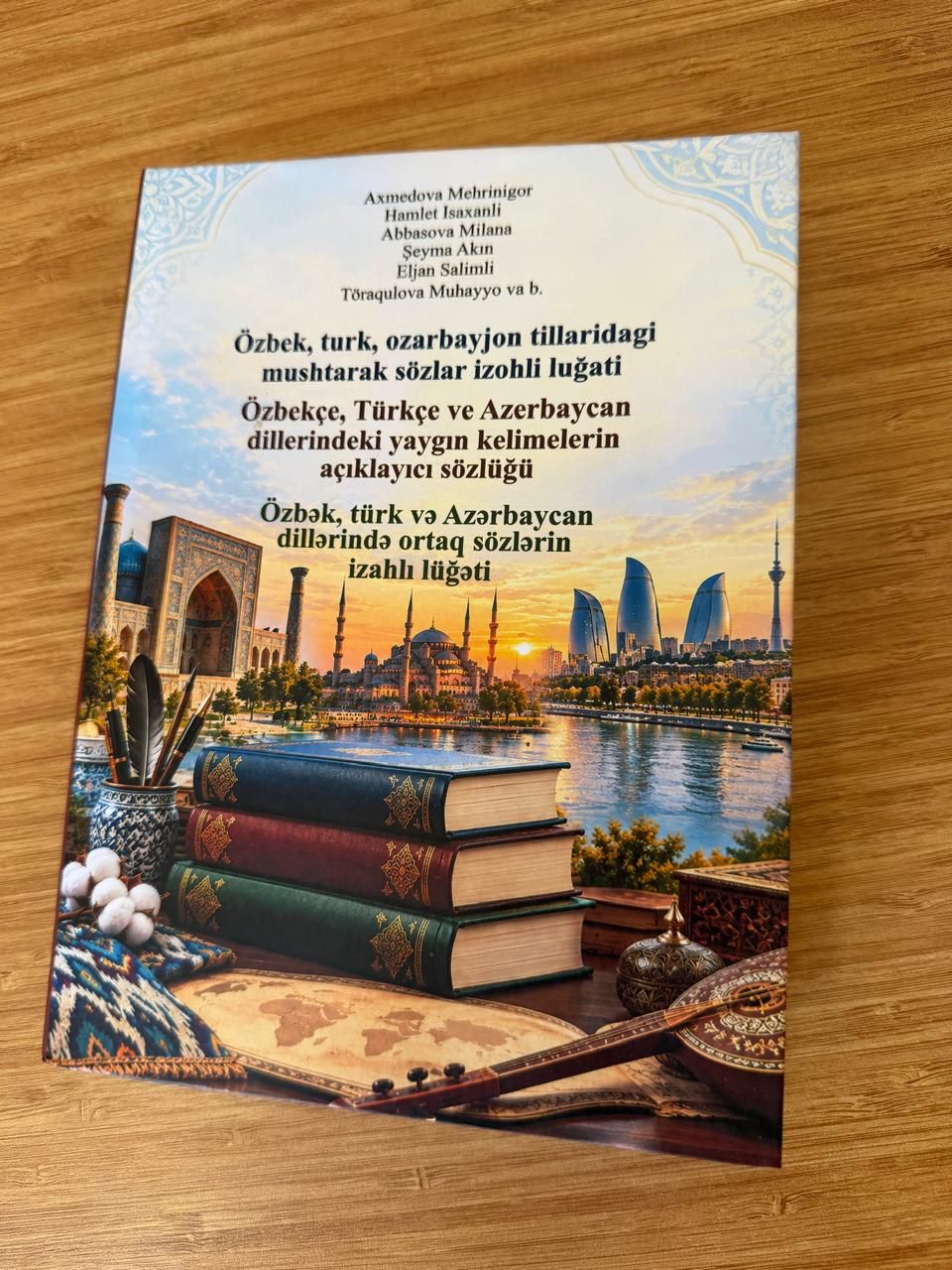
Another important step has been taken toward strengthening cultural and scientific ties among the Turkic peoples. With the joint cooperation of scholars from Uzbekistan, Türkiye, and Azerbaijan, an "Explanatory Dictionary of Common Words in the Uzbek, Turkish, and Azerbaijani Languages" has been compiled.
By systematically identifying lexical, phonetic, and semantic similarities among the three languages, this scientific project brings together the common linguistic heritage of the Turkic world. The creation of the dictionary involved significant scholarly effort by an international team.
The Azerbaijani-language part of the project was compiled by Prof. Acad. Hamlet Isakhanli, founder of Khazar University and Chairman of the Board of Directors and Trustees; Milana Abbasova, PhD in Philology and Dean of the School of Humanities, Education and Social Sciences; and Elcan Salimli, a doctoral student of the university specializing in Germanic languages. Alongside them, Prof. Akhmedova Mehrinigor Bahodirovna and Muhayyo Sevdiyor To'raqulova, PhD in Philology, from Uzbekistan, and Prof. Şeyma Akın from Türkiye took part as co-authors.
This scientific resource has been highly appreciated by Uzbekistan's Ministry of Education and welcomed as a commendable initiative in terms of scientific and cultural cooperation.
The "Explanatory Dictionary of Common Words in the Uzbek, Turkish, and Azerbaijani Languages" is not merely a resource covering lexical units, but also a valuable scientific source that strengthens spiritual bridges among the Turkic peoples and lays the groundwork for future joint research in linguistics.
The dictionary enables students learning the Uzbek, Turkish, and Azerbaijani languages, translators, linguists, and a wide readership to gain a deeper understanding of the historical and modern linguistic ties among the three languages. By giving each word's main form in Uzbek together with its equivalents in the other two languages, its semantic explanation, and, where necessary, historical notes, it allows users to quickly and accurately identify similarities and differences among these languages.
Published in Uzbekistan, this valuable publication is an important contribution that reveals the lexical richness of the Turkic languages, rests on scientific foundations, and develops cultural cooperation.


Copyright © Khazar University, 2026
