Dr. Yagub Heydarzade, professor at Turkey's Bilkent University, was a guest of the Center for Theoretical Physics at Khazar University from August 23 to 30.
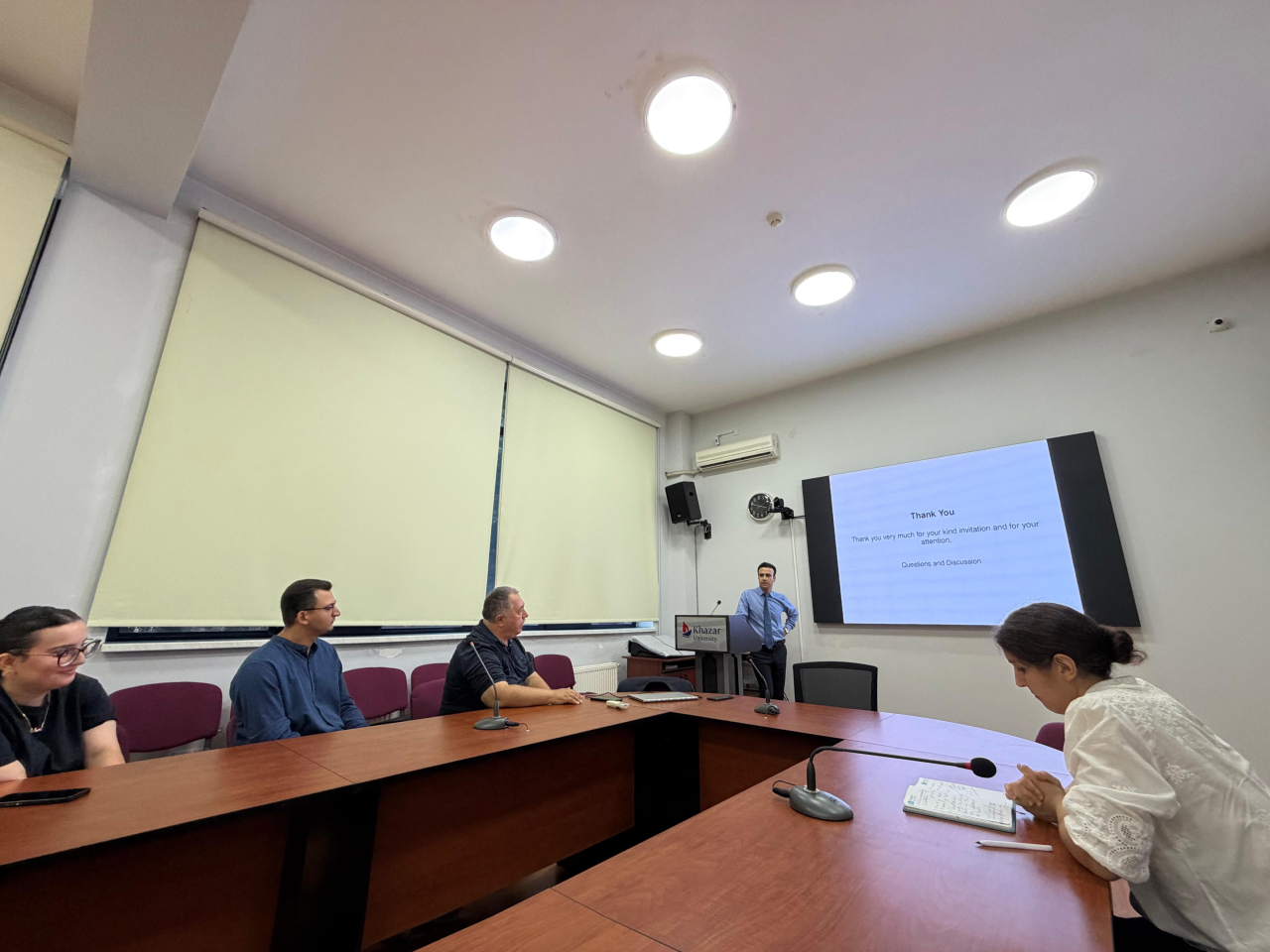
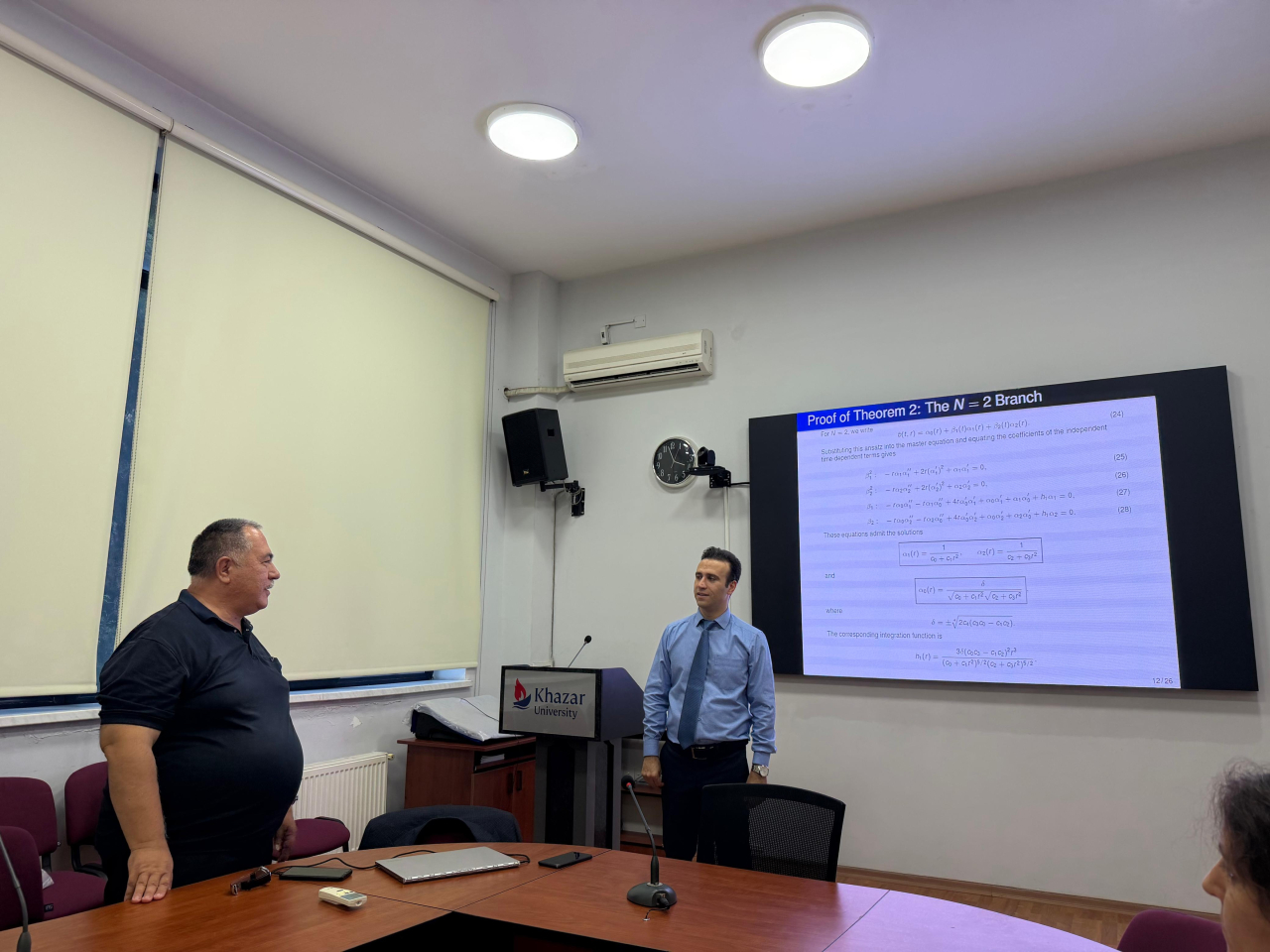
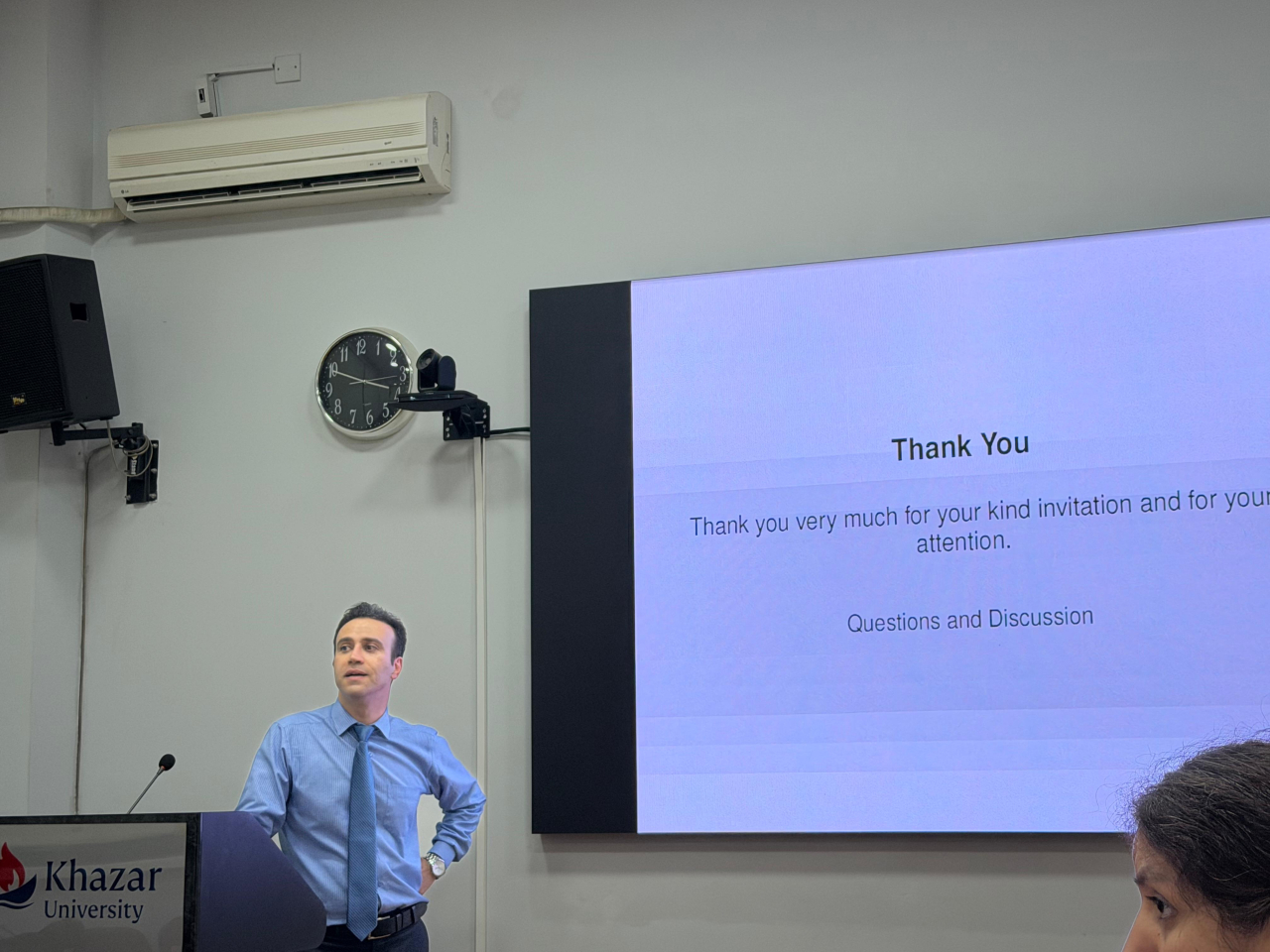
As part of the visit, on August 26 Dr. Yagub Heydarzade delivered a seminar at the Center for Theoretical Physics titled "The Dance of Two FLRW Universes: A Possible Geometric Origin of Cosmic Inhomogeneities."
The presentation addressed one of the important problems of modern cosmology — the structure of the universe at large and small scales. The professor noted that the Friedmann–Lemaître–Robertson–Walker (FLRW) geometry successfully describes the large-scale structure of the universe, but the observed universe is highly inhomogeneous at smaller scales.
During the seminar, possibilities were presented for cosmic inhomogeneities to arise on the basis of an exact and fully nonlinear geometric structure, rather than being added as perturbations to an initially homogeneous FLRW background. Dr. Yagub Heydarzade discussed exact spherically symmetric solutions of the Einstein–Maxwell equations together with a perfect fluid and cosmological constant.
The results presented showed that, as a result of a certain geometric structure, spacetime loses spatial homogeneity, and the energy density, pressure and curvature invariants acquire radial dependence. An interesting point is that these inhomogeneities can arise as a result of the interaction of geometric structures, each of which is individually homogeneous.
The seminar attracted great interest among students and researchers of the Center for Theoretical Physics. Following the presentation, extensive scientific discussions were held on the topic, and participants' questions were answered.
Dr. Yagub Heydarzade's visit to Khazar University is of great importance for the development of the Center for Theoretical Physics's international scientific cooperation and the expansion of scientific relations in the field of theoretical physics.


Copyright © Khazar University, 2026
